

Article
Zagorje Startup Answers the Labor Market's Key Question
The Croatian labour market is undergoing significant change. As labour shortages continue to grow, foreign workers are becoming an essential part of the economy, yet their successful integration remains a challenge for employers, institutions and local communities alike. In article from poslovni.hr, we explore current labour market trends, recent legislative changes and the story behind the creation of CroWork.
Author
Siniša Malus
In the context of an increasingly pronounced labour shortage, particularly when it comes to qualified workers, stronger links between the education system and the economy, as well as greater investment in developing skills that correspond to the actual needs of the labour market, are essential. We have been living with this reality for several years now, ever since quotas for foreign workers were abolished in 2021 due to the growing labour shortage caused by increasing emigration. Emigration reached its peak in 2017, when 47,352 Croatian citizens left the country.
The Labour Market Cannot Do Without Foreign Workers
At the end of 2025, according to official data from the Croatian Government, namely the Ministry of the Interior (MUP), a total of 170,723 residence and work permits had been issued in Croatia. Of this total, 80,365 permits were issued for new employment, meaning that this number of foreign workers came to Croatia for the first time. At the same time, 70,275 work permits were extended for foreign workers who had arrived in Croatia in previous years. A further 20,083 permits were issued for seasonal employment.
Last year, the largest number of permits was issued to workers from Bosnia and Herzegovina (32,225), Nepal (31,708), Serbia (24,278), the Philippines (17,629), India (15,400), and North Macedonia (11,856).
The foreign workforce is becoming an increasingly important segment of the domestic labour market. Currently, 29% of employers employ third-country nationals, while another 8% plan to employ them in the future. The majority of foreign workers have secondary vocational qualifications (72%), while 24% of employers also employ highly educated foreign workers.
Employers identify learning the Croatian language as a key prerequisite for successful integration. The fact that as many as 76% of employers are looking for workers, while at the same time 65% are facing a shortage of suitable candidates, clearly illustrates the scale of the challenge facing the labour market. We are no longer talking simply about a shortage of workers, but about a shortage of the skills the market actually needs.
The greatest demand for workers is in the manufacturing, trade and retail, administration, logistics and warehousing sectors. Employers point out that it is most difficult to find workers with secondary vocational qualifications, but also highly educated and low-skilled workers.
New Legislation
Recently, amendments to the Foreigners Act were sent to the Croatian Parliament for a third reading. The amendments introduce a system for conducting in-depth checks of third-country nationals at external borders, granting asylum at the border, and a border return procedure for third-country nationals whose asylum applications have been rejected.
With regard to the labour market, the amendments are expected to result in a reduction of the administrative burden for all stakeholders involved in the process of issuing permits, more efficient implementation of the procedure, as well as improved protection of workers who are third-country nationals.
For foreign workers, a new requirement is being introduced for the extension of their residence and work permits: after one year of residence in Croatia, they will be required to learn Croatian and pass a Croatian language examination. At the same time, they will be able to change employers more easily after six months of employment with their first employer, without the need to obtain a new residence and work permit.
The permitted period of unemployment during the validity of a foreign worker’s permit is also being extended to up to three months, or up to six months if the worker has held the permit for more than two years.
It was precisely the growing need for more intensive integration of foreign workers in Croatia that inspired Olga Berezina to launch the CroWork project, which aims to help foreign workers feel at home in Croatia.
A Personal Connection to Integration
Berezina herself has experienced what it is like to live in Croatia as a foreigner, at a time when foreigners in Croatia were, in a sense, still something of a rarity.
“I arrived in Croatia in 2007, when I was the only Asian woman in my neighbourhood. However, this trend has changed significantly in recent years,” Berezina told PD Vikend. She has been living in Croatia for almost two decades, which is precisely why she has a particular sensitivity to the challenges faced by foreign workers in Croatia.
Foreign workers, recruitment agencies, learning Croatian, and integration have become buzzwords in the Croatian business environment. It is easy to place the blame for the difficulties that have arisen, and continue to arise, on the incompetence of the state or the greed of employers. We often look at foreign workers solely through the lens of their connection to employment, forgetting that they are, first and foremost, people and that they are becoming part of today's Croatian society.
“I believe in social responsibility, which has no political connotations, but is simply part of our everyday lives. For the past four years, I have been volunteering and organising integration courses in cooperation with the Inicijativa association. Participants often ask me whether I have friends here and whether I like living in Croatia.
“I was 24 when I arrived in Zagreb, and I believe that my Croatian friends, colleagues and my new family shaped me greatly. Integration is part of my life story,” Berezina says.
The idea for this unique Zagorje-based startup emerged naturally. Through her everyday contact with foreign workers, she noticed that many of them had become somewhat isolated. They live their lives to the fullest during working hours, while their time outside work is often not filled with meaningful activities or opportunities to build a life in the local community.
The founders of the project have known and worked with each other for an entire decade, collaborating on various projects. Now, their focus is CroWork – a job-search platform and integration platform tailored to the needs of foreign workers already living in Croatia.
Direct Communication
“Foreign workers have been present on the Croatian labour market for some time now, and there are no indications that the need for them will decrease. However, there is still no transparent system or tailored digital platform that connects employers, candidates and the onboarding process in one place,” Berezina explains.
CroWork is a startup created within the Entrepreneurial Centre of Krapina-Zagorje County. This is no coincidence, as the Entrepreneurial Centre of Krapina-Zagorje County brings together professionals with extensive experience in various areas of business and entrepreneurship development, providing comprehensive support to its clients.
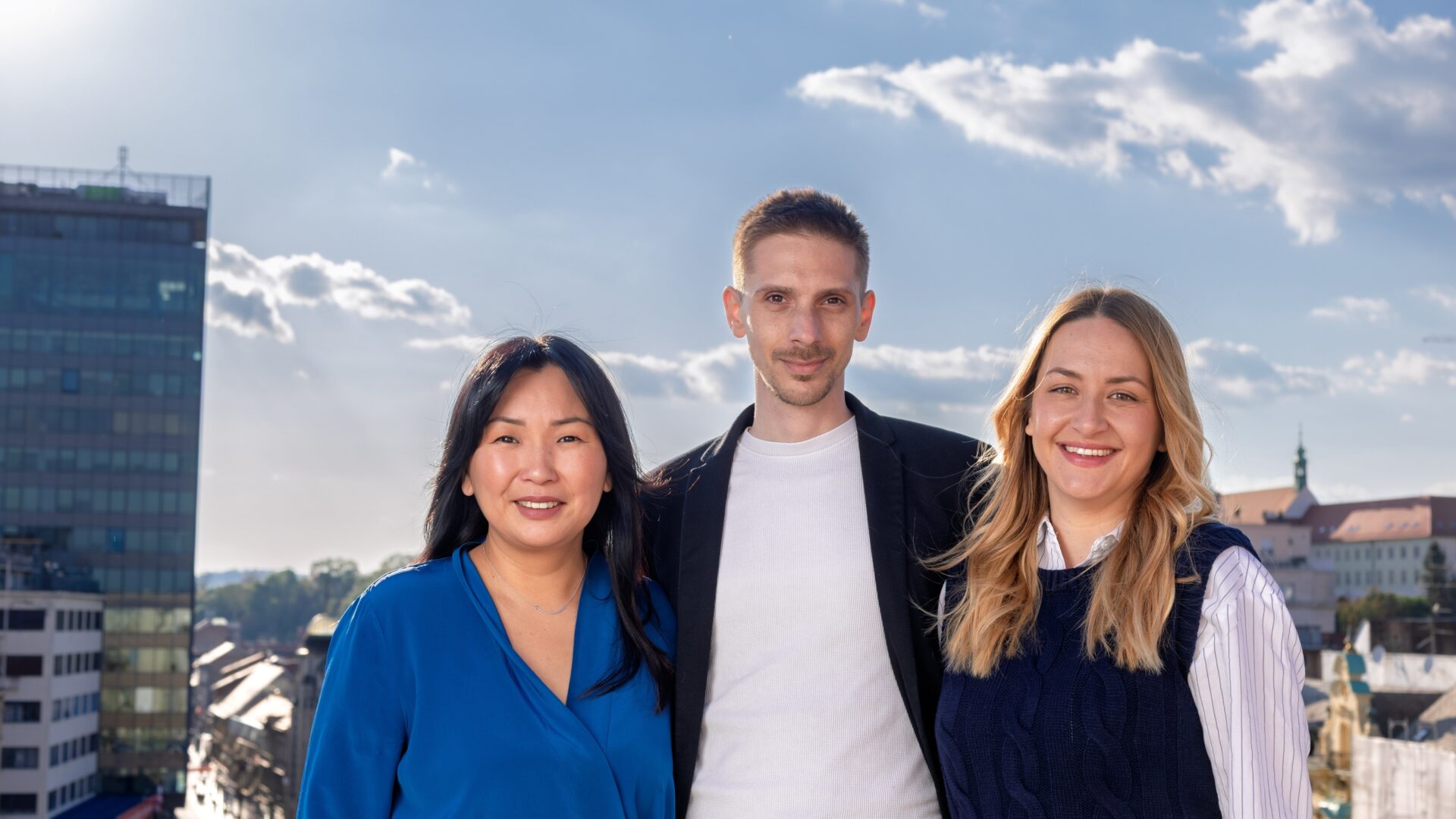
The CroWork team consists of Nives Hrgić from Tangerine, responsible for digital development; Mate Vukčević from GoodCo, responsible for web development; and Olga Berezina from Nomad Vision, responsible for business development.
“Our vision for the platform is to encourage direct communication between employers and workers while providing support for integration. We always have a choice about which direction to take. This is a challenging period, but it is also a great opportunity for the development of entrepreneurship and the economy as a whole,” Berezina says.
She believes that communication between domestic and foreign workers, and particularly the first days of a foreign worker's life in Croatia, are extremely important, because changing habits is one of the most difficult things to do.
“During my 18 years in Croatia, I have met many highly educated foreigners who have never learned Croatian. Although it is possible to communicate in English, since many people in Croatia speak it, this can often be a double-edged sword and negatively affect people's motivation to learn and communicate in Croatian.
“My life in Croatia is much richer because I can express myself, sometimes even argue, ask for a discount and negotiate. I can simply live a normal life, the way I believe everyone should and the way I would recommend to anyone who has chosen Croatia as their home,” Berezina concludes.
CroWork is set to begin operating at the end of May, and intensive communication with entrepreneurs is already underway in order to involve as many of them as possible in this truly pioneering project in Croatia. Interest is already considerable, so the friendly CroWork team has every reason to expect its activities to expand significantly this summer.
This is particularly relevant because it is well known that a large number of foreign workers live and work precisely in Hrvatsko Zagorje, which was a decisive factor in launching this story in this part of Croatia.
The Zagorje Connection
There is one more dimension to this story that shows why it is no coincidence that the project was launched precisely in Zagorje.
Over the past four years, Krapina-Zagorje County has attracted more funding from European funds than any other Croatian county. Between 2021 and 2024, the county secured as much as €98.97 million, equivalent to €819 per capita.
Since all Croatian counties together attracted €712 million, one in every eight euros ended up precisely in Zagorje.
The fact is that Zagorje has been developing an open and inclusive ecosystem for years, in which a small family business, a technology startup and an industrial leader all have an opportunity, while the county takes on the role of a reliable coordinator.
Its strength lies in turning strategy into practice. From the Invest in Zagorje platform to incubators and talent programmes, the county has demonstrated that it knows how to connect local needs with European priorities related to the green and digital transitions.
Croatia must finally develop well-designed education policies as well as new policies for welcoming and integrating foreign workers, given that the majority of foreigners currently working in Croatia come not only from Southeast Europe but also from Asia.
If the Croatian economy continues to grow at the same pace over the next five years, by 2030 the country could face a shortage of up to 500,000 foreign workers.
The integration of these workers requires broad cooperation not only between employers and state institutions, but also with local and regional authorities.
This is precisely where projects such as CroWork see their role.
Author: Siniša Malus
This article was originally published by Poslovni.hr and is republished here with permission. The original article is available in Croatian.